1 · Detect
RF detection finds drones and pilots across 70 MHz to 6 GHz or 6.2 GHz, depending on the product; the DD-R series radar watches for small targets that emit nothing.

Integrated systems
Detection, verification and response work best as one chain. AirdomeTech systems combine full-band RF detection with directional or omnidirectional jamming, and connect to radar, EO/IR and navigation-spoofing equipment.
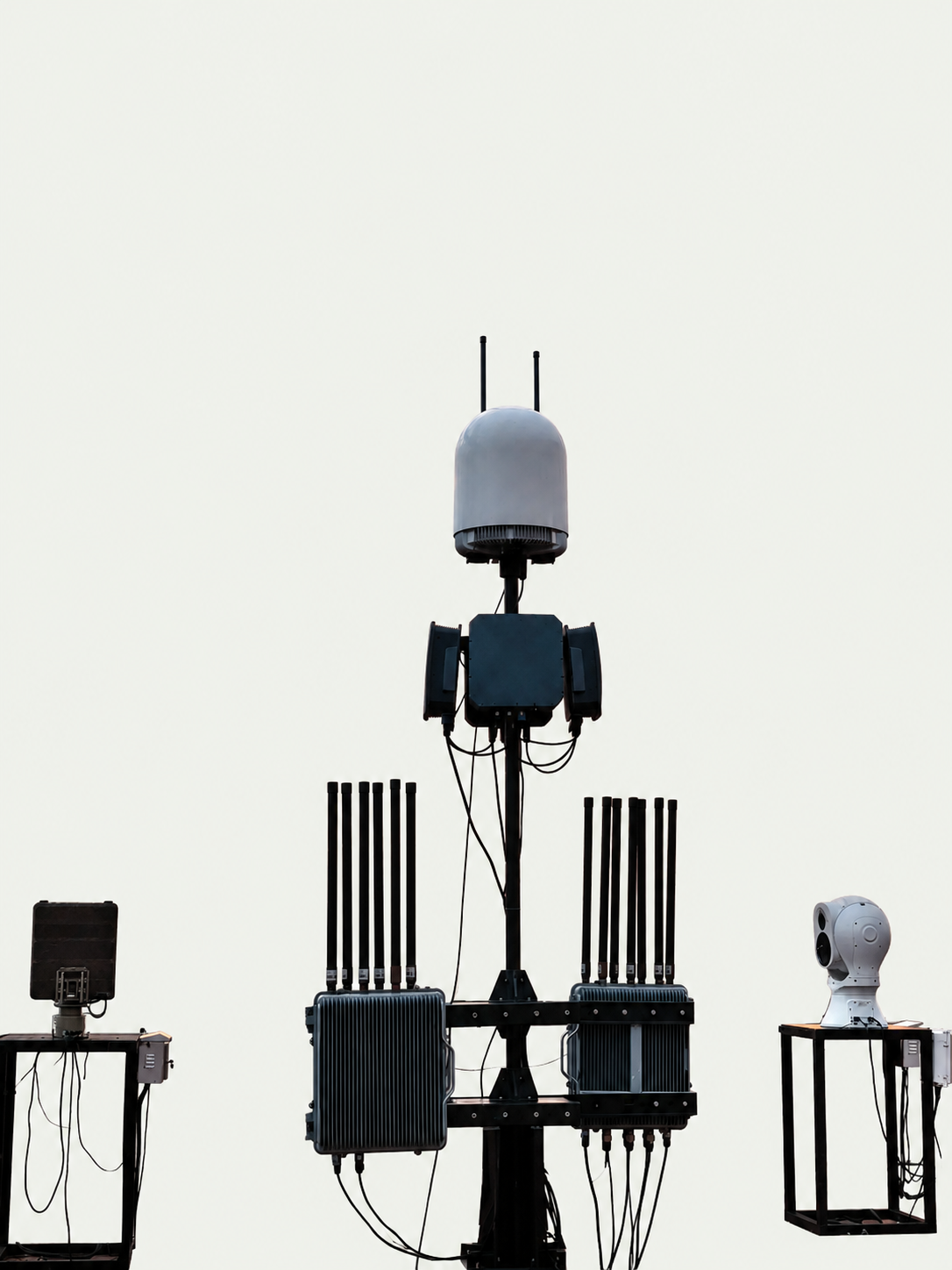
Each layer answers a different question. The operator, not the equipment, decides how to respond.
RF detection finds drones and pilots across 70 MHz to 6 GHz or 6.2 GHz, depending on the product; the DD-R series radar watches for small targets that emit nothing.
EO/IR heads slew to the track, confirm the target visually and thermally, and record video.
Directional or omnidirectional jamming, or navigation spoofing, is applied by authorised operators according to local rules.
Choose by how the system will be deployed. Specifications come from the current product sheets.
| Deployment | Model | Reach | Weight | Protection |
|---|---|---|---|---|
| Fixed-site | DR200-C | 5 km detection · ≥ 3 km jamming · 360° · 13- or 16-band customisable | ≤ 170 kg | IP66 |
| Portable | DR500-AB | ≥ 2 km detection and jamming · six channels | 6.45 kg main unit + 1 kg battery | — |
| Vehicle-mounted | DR100-AB | 5 km detection · ≈ 3 km jamming · vehicle speeds up to 150 km/h | ≤ 50–57.6 kg | IP65 |
| Navigation spoofing | DR200-S1 | 1 km defence radius · 6 GNSS frequency points | ≤ 11 kg | IP66 |
Ranges depend on drone model, terrain and electromagnetic environment. See each product page for conditions.
Authorised users only. Jamming and navigation-spoofing equipment is supplied only to authorised government, military and security users. Purchase, import and operation are subject to the laws of the destination country.
FAQ
A detection-to-response chain in one system: RF detection and radar find the drone, EO/IR verifies it, and authorised operators respond with jamming or navigation spoofing according to local rules.
For permanent sites, the DR200-C fixed system; for teams on the move, the DR500-AB portable unit; for convoys and routes, the DR100-AB vehicle-mounted system; for GNSS-based area denial, the DR200-S1.
Integration with existing radar, cameras and command systems is discussed per project. The DR200-C extends with radar, EO/IR and navigation-spoofing products, and the DR200-S1 has a network interface for other platforms.
Describe the site, the threats and who will operate it. We will propose a sensor and response mix.