Remote ID broadcast coordinates
A Remote ID receiver decodes the identity and flight information a supported aircraft broadcasts. Its displayed coordinates depend on that transmitted data.

Technology · RF sensing
Most drones talk to a controller, a phone or a video receiver. OmniRF-Sense listens passively for those radio links, identifies the drone and, for supported protocols, locates both the aircraft and the pilot.
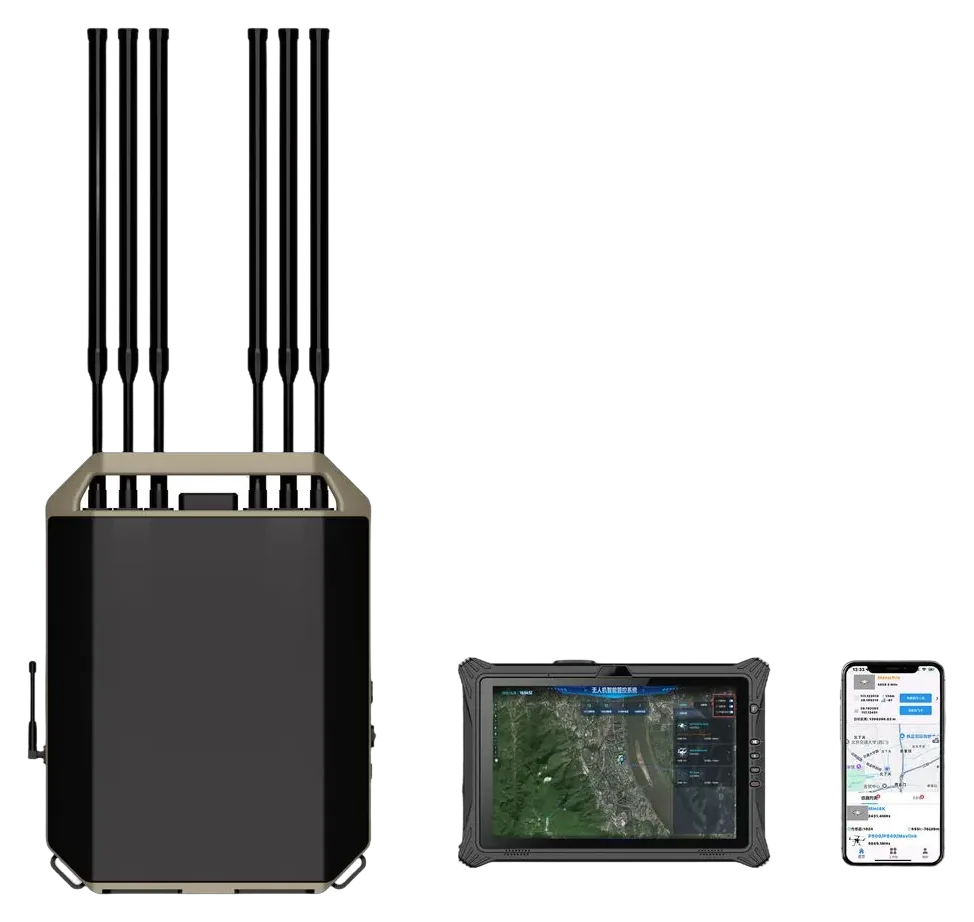
Choose by the information your monitoring installation needs: Remote ID broadcasts, supported protocol-based location data, RF bearings, and the required deployment mode.
A Remote ID receiver decodes the identity and flight information a supported aircraft broadcasts. Its displayed coordinates depend on that transmitted data.
Compatible DID/RID signals can provide aircraft or controller position information when the supported protocol and transmitted data make it available. Availability varies by model and configuration.
Direction finding provides the direction of a supported radio signal. A bearing by itself does not provide a complete geographic position.
| Model | Consider it for | Information available | Deployment | Configuration |
|---|---|---|---|---|
| DR200-RID | Receiving supported drone Remote ID broadcasts at a monitoring point. | Broadcast identity and flight information. Any coordinates come from the received broadcast data. | Fixed monitoring point. | Remote ID broadcast reception is the primary function. Wider-band RF detection and DID parsing are optional. |
| DR200-A | RF monitoring and supported protocol-based location data for a fixed installation. | RF monitoring information and available aircraft or controller data from supported DID/RID protocols. | Fixed monitoring point. | Supports DID/RID decoding and direction finding in the specified RF bands. Signal acquisition and AI-assisted database expansion are optional. |
| DR200-TD-A | Monitoring installations that need RF signal bearings alongside supported decoded identity and location data. | RF bearings, plus identity and location data decoded from supported DID/RID signals. A bearing alone is not a complete geographic position. | Fixed or vehicle-mounted installation. | Detection and direction finding use different frequency bands. Signal collection and AI-assisted database expansion are optional. |
| DR600-A | RF detection and supported positioning when the equipment may move between monitoring locations. | RF detection and available aircraft or controller positions from supported protocols. | Backpack, fixed or vehicle-mounted use. | DID/RID decoding depends on supported protocols and drone models. Analog FPV video reception and recording are optional. |
Compare each result with the conditions attached to it: broadcast data, RF detection, decoded positions and signal bearings describe different measurements.
| Application and model | Published specification conditions |
|---|---|
| DR200-RID Remote ID broadcast reception. | Position accuracy follows the aircraft’s Remote ID broadcast. Reception distance and coordinate accuracy are separate characteristics. Wider-band RF detection and DID parsing are optional. |
| DR200-A Fixed RF monitoring with supported protocol-based position data and direction finding in specified bands. | Detection: line of sight, with electromagnetic noise stated as −90 to −95 dB. The ≤5 s response-time figure uses a line-of-sight test with the target within 500 m. Direction-finding accuracy is specified without obvious obstructions or interference. |
| DR200-TD-A RF bearings with supported identity/location data, for fixed or vehicle-mounted monitoring. | Detection: line of sight and electromagnetic noise stated as −90 to −95 dB. The ≤5 s response-time test places the target within 500 m. Detection covers 70 MHz–8 GHz; direction finding is specified separately at 300 MHz–6 GHz. |
| DR600-A RF detection and supported positioning for backpack, fixed or vehicle-mounted use. | Detection and positioning figures specify line of sight and electromagnetic noise of −90 to −95 dB. The FPV detection condition includes transmitter power ≥2.5 W. Analogue FPV video reception and recording are optional; their specifications also state transmitter-power and altitude conditions. |
Capabilities above come from the product specification sheets listed here.
FAQ
RF drone detection listens for the radio links a drone uses to talk to its controller, phone or video receiver. OmniRF-Sense scans 70 MHz to 6.2 GHz (6 GHz on the DR200-C and DR100-AB), identifies the drone and, for supported protocols (DID / RID), locates both the drone and the pilot.
No. RF detection is passive: the sensor does not transmit while detecting.
A drone that flies with no radio link at all will not be seen by RF alone. Pair RF detection with radar for that case.
The DR600-A detection and positioning device, the DR400-D handheld detector, the DR200-C fixed system and the DR100-AB vehicle-mounted system.
Tell us about your site, environment and team. We reply by email.